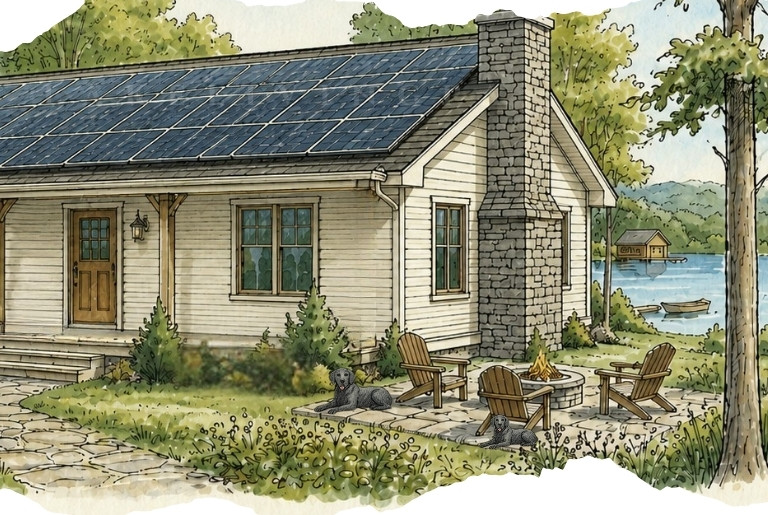
If you are selling a home with solar panels around Lake Wallenpaupack or in the Northern Poconos, the panels can either help you, sit there being neutral, or possibly slow the whole deal down. Which one you get depends less on the panels themselves and more on two things: ownership details of the system, and whether your paperwork is ready when a buyer starts asking in-depth questions. Here is how solar may impact you when it is time to sell, and what to have in order before you list.
Owned vs. leased, seller’s perspective
When selling a home with solar panels, “owned outright” is the cleanest and most ideal version. The system is part of the real estate, it transfers with the house, and when there are comparable sales to support it, an appraiser can recognize some value for it.
Leased or on a PPA (Power Purchase Agreement) is where things may become murky. A solar company owns the panels, so a buyer has to be willing to qualify for and assume the loan or lease, or you prepay or buy it out before closing. Plenty of buyers may not qualify or simply say no to inheriting a long-term lease or loan agreement, even a reasonable one. This can significantly narrow your buyer pool. Also worth noting: appraisers cannot assign value to a system you do not own.
What the value studies really show
Solar frequently gets marketed as a guaranteed home value and/or resale boost, usually on the strength of (very) broad studies showing solar homes sell for more. Those numbers are real, but take the sources with a grain of salt. Information may be outdated and exaggerated.
A figure many people may quote for Pennsylvania, about a 4.9 percent premium, comes from a Zillow study published in 2019. It is several years old now, it was a national analysis that flagged the states with the highest premiums, and it identified solar homes by scanning listing descriptions rather than by separating owned systems from leased ones. A 2024 update from SolarReviews, replicating Zillow’s method on more recent sales, put the national premium (value increase) higher, around 6.8 percent, with Pennsylvania near 6.3 percent, though that one ran on a small sample. An older Lawrence Berkeley National Laboratory study that appraisers often cite found roughly four dollars per watt of value for owned systems.
Here is the part that matters for our market. Every one of those is a broad average pulled from places with lots of solar sales. The greater Lake Wallenpaupack area is a smaller, vacation-heavy market, and there may simply not be enough recent local sales of similar homes with similar systems for an appraiser to support a premium, even on an owned system. So, the takeaway here is: treat solar as a marketability feature first and a value boost second, unless your specific situation has clear, recent local comps behind it.
Appraisal and financing: why solar value can be hard to prove
Even if a buyer absolutely loves your setup, the deal still has to clear financing. Under Fannie Mae’s guidelines, an owned system can be included in the appraised value through the normal appraisal process. A leased system, a PPA, or one separately financed with a lien on the equipment must be treated as personal property and kept out of the appraised value.
Financing also drives the closing mechanics. A secured solar loan usually has to be cleared before the sale can close, most often paid off from your proceeds. A PACE loan repaid through the tax bill has to be paid off at or before closing for the buyer to use a conforming mortgage. It’s important to know the full details of the agreement you have with the solar company!
Roof and shade: the questions buyers actually ask
Solar almost always raises roof questions, and in Northeastern PA, it raises shade questions too. Buyers and inspectors tend to ask the same things: how old was the roof when the panels went on, were permits pulled and the work inspected, are there leaks near the mounts, and what does it cost to remove and reset the panels if the roof ever needs replacing. Because tree cover is real in the Poconos, buyers also ask how much sun the roof gets across the seasons. If your system performs well even with some shade, a simple production summary answers those questions up front.
A seller’s prep checklist
A little preparation keeps solar from becoming the thing that spooks a buyer or stalls the deal:
- Clarify the ownership type and be able to prove it. Owned, financed, or leased/PPA, with the balance and terms if there is a contract.
- Gather the documents. Contract or proof of ownership, warranty and transfer steps, permit and inspection records, system specs, and who services it.
- Provide a production snapshot. A screenshot or two of annual output is enough.
- Be ready for roof questions. Age, condition, and the remove-and-reset cost if needed.
- If it is leased or a PPA, confirm the transfer requirements early. Buyer qualification, timeline, fees, and any payment escalators.
The takeaway for Lake Wallenpaupack and Poconos sellers
Solar can be a plus when you sell. It can also complicate things when the contract, the lien, or an unanswered roof question enters the chat. Do not assume that selling a home with solar panels will automatically increase value, expect detailed & specific buyer questions, and have all of the paperwork ready. If you are thinking about selling and want to know how your particular setup is likely to land with today’s buyers, I am happy to help you navigate the process, starting with a current market valuation.
Read Part 1: Do solar panels actually save money in the Poconos? The local realities, the contract traps, and what the savings pitch tends to leave out.
Curious what your Pocono home is worth today?
Start with a current market valuation, then we can talk through how your solar setup, your roof, and recent local comps factor into the number.
Get Your Market ValuationOwn the View. Love the Life.
Frequently asked questions
Do solar panels increase a home’s value in the Poconos?
Maybe. It can be a boost if the system is owned outright and there are recent local sales of similar solar homes to support it. The greater Pocono Mountains and Lake Wallenpaupack real estate market is small and vacation home heavy, so local comps to justify a higher appraisal can be thin. Solar tends to help marketability more reliably than it raises the appraised value.
Can I sell my home if I still owe on a solar loan?
Yes. How it works depends on the loan. An unsecured loan stays with you and can be paid from the sale proceeds or carried separately. A secured loan is usually tied to the equipment through a UCC-1 lien that has to be cleared before closing, most often paid off from your proceeds at settlement.
Are leased solar panels harder to sell than owned ones?
They definitely can be. With a lease or PPA (Power Purchase Agreement), a buyer has to qualify and assume the contract, or you prepay or buy it out before closing, and appraisers cannot count a system you do not own toward value. Owned, well-documented systems are simpler to position and to transfer.
About the author


Leave a Reply