

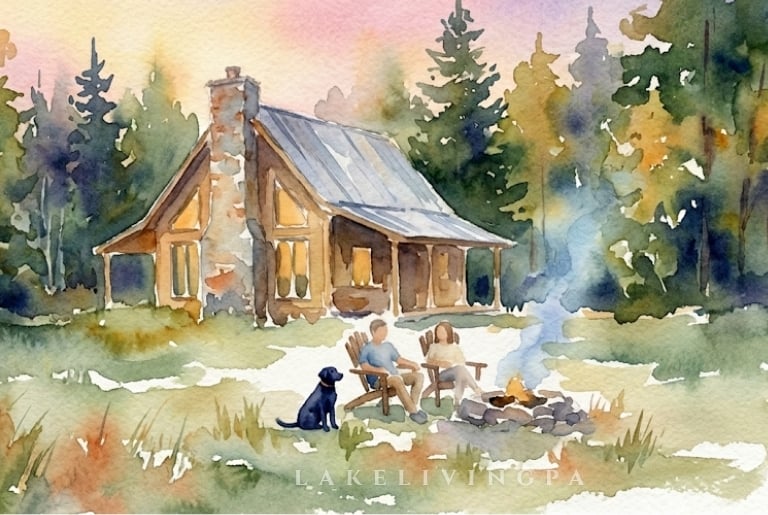
Buyers budget down to the penny for the mortgage, HOA fees, utilities, and taxes…and then…the homeowner’s insurance quote enters the chat. A lake house in the Northern Poconos usually costs more to insure than the house you live in full time, and the reasons are pretty specific. Here is what carriers are looking at when they quote insurance on a lake house in the mountains.
Vacancy Is Most of the Problem
A vacation home that sits empty five days a week, or five months a year, is a different risk than a house somebody lives in all the time. A pipe that bursts on a Tuesday in a primary residence is a wet floor. The same pipe in an empty lake house is a wet floor for eleven days and might require a snorkel.
I was showing a home in Wallenpaupack Lake Estates one January several years ago, and as I unlocked the door, I heard a noise like a waterfall. I told my buyer that it sounded like someone was in the shower, but the house was supposed to be unoccupied. Imagine our surprise as we stepped inside to find soaking wet carpets and water gushing from the ceiling: the upstairs bathroom pipes had frozen and then burst. The listing agent gasped “Oh nooooo!” when I called to give her the news. I can’t imagine what the seller said!
Carriers consider this a high risk and price homeowner’s insurance for vacation homes accordingly. Some policies also carry conditions about how long the house can sit unoccupied, or what you have to do to keep it protected while you are gone, like keeping the heat on or shutting off the water. Be sure to read those conditions rather than assuming you understand them, because compliance with them is the part that decides whether a claim gets paid.
Water Damage, and Which Kind Is Covered
Water damage is the most common claim on lake house and vacation home properties, and the coverage is more particular than people expect. Burst pipes, roof leaks, groundwater intrusion, and flooding are all treated differently, and flood insurance is a separate policy entirely.
Being near a lake does not automatically mean you need flood coverage, however, and not being in a mapped flood zone does not automatically mean you do not. On a lot that slopes toward the house, spring snowmelt or heavy rain can be the bigger issue. It is worth a detailed conversation with your homeowner’s insurance agent up front, rather than later on after a catastrophe has occurred.
Wood Stoves, Fireplaces, and Older Wiring
A lot of the appeal in the Pocono Mountains comes with a woodstove or a beautiful stone fireplace, and carriers look at both, though not equally. Blayre Scorzetti of Safeguard Home & Auto, the insurance agent I refer my clients to, says a fireplace by itself is not an obstacle to getting coverage, although an inspector will examine the chimney and the flashing. Woodstoves are the bigger concern. Carriers want to know how the stove was installed and whether it has proper clearances, and the scrutiny goes up for short-term rentals. Some companies simply will not insure a short-term rental with a woodstove in it.
Same with knob and tube wiring (fortunately we don’t see that too often anymore), older or recalled electrical panels (Federal Pacific, I’m talking about you), and buried oil tanks. None of these are automatic dealbreakers, but any of them can change the premium or shrink the list of carriers willing to quote. If you are buying, ask about them early, because the day after your inspection contingency expires is a terrible time to learn that no insurance carrier will touch the house.
How Far You Are From a Fire Hydrant
Distance to a responding fire station and to a water source directly impacts your rate. Insurance companies call this Protection Class, and it is one of the major factors in setting a premium. According to Blayre, the Insurance Services Office (ISO) grades each community’s fire protection on a scale from 1 to 10, with 1 being the best and 10 meaning virtually no protection. The grade comes from three things: the fire department itself (equipment, staffing, training, and how its stations are spread out) counts for 50 percent, the water supply and hydrants count for 40 percent, and the alarm and dispatch system counts for the remaining 10 percent.
Classes 9 and 10 are both considered “unprotected,” which describes rural areas without adequate hydrants or fire departments. Which of the two a home falls into depends on its distance from a usable hydrant and from the fire department that would respond. Plenty of properties around Lake Wallenpaupack and the surrounding lake communities sit farther out than an insurance algorithm likes, and the difference between a house a mile from a hydrant and one five miles out shows up on the bill.
Unless a home is located inside a town or planned community with a central water system, there simply won’t be a nearby fire hydrant. To bridge that gap, rural volunteer fire departments rely on tankers to haul water directly to the scene, refilling their trucks at local lakes and ponds. While these departments are resourceful and well-trained in managing rural water supply, the lack of a pressurized hydrant system is a major detail that homebuyers (and their insurance carriers) must factor in.
You can't change it, of course, but it helps to know the higher rate is just a quirk of the location, not a judgment on the house itself.
The Dock, the Boat, and the Liability
The dock on a lakefront property is a structure, and whether your policy covers it is a question that many owners have never asked. Boats are usually insured separately. Docks are sometimes separate too.
Liability is the piece worth the most attention. People swim off your dock, ride in your boat, and gather around your lakeside fire pit. Look at the liability limit rather than only the premium, and ask about an umbrella policy, which is often inexpensive relative to what it covers.
Renting Changes Everything
If the house takes paying guests, the policy needs to reflect that. A standard homeowner or dwelling policy generally does not cover commercial use, and finding that out at claim time is the worst possible timing. Tell your homeowner insurance agent that you intend to rent before the first booking, not after the first problem occurs.
The same goes for ownership. If the house is held in an LLC or a trust, particularly one set up to rent it out, Blayre says that needs to be disclosed up front, and it has to match the financing if there is a mortgage. Getting a quote in your personal name and switching it over afterward can affect the rate, and even which company will write the policy.
How to Keep the Number Reasonable
- Do not expect much of a break for an alarm system. Blayre says alarm discounts are not what they used to be, maybe $15 to $20 a year. Homes over $1 million in rebuild value, however, need a centrally monitored system to be insured at all.
- Put the money into water sensors instead, which Blayre recommends. They cost little, send alerts to your phone, and can catch a burst pipe before it becomes a major claim. Low-temperature sensors and automatic water shutoff valves are worth asking about too.
- Line up someone local who can physically check the house, especially from December through March.
- Keep records of updates to the roof, heating system, electrical, and plumbing. Carriers price the house they can document.
- Get quotes before you are under contract, not after. A surprise here is easier to handle when you still have time to negotiate.
Full disclosure: I’m a Realtor, not an insurance agent, and I always make a point to stay in my lane. Consider this the “big picture” of what to expect, rather than advice on your specific policy. Carrier coverage rules shift constantly, so your best move is talking to a local insurance agent who writes policies on primary and second homes every day.
As I mentioned above, my go-to person for my clients is Blayre Scorzetti at Safeguard Home & Auto. Since she writes for at least 22 different carriers, she isn't stuck trying to force your house into one company's box. She can shop around to find who is actually writing lake properties right now. For a more detailed explanation of anything covered here, or for other insurance questions, give her a call at (610) 255-7777 Ext. 1 or connect with her online.
Common Questions
Why is insurance on a lake house more expensive than my primary home?
Mostly vacancy, water risk, and distance from fire protection, which carriers rate as Protection Class. A property that sits unoccupied for stretches carries more risk of a small problem becoming a large one, and many lake properties are farther from a hydrant than carriers prefer.
Do I need flood insurance on a lakefront property?
Not automatically. Being near water does not by itself put you in a mapped flood zone, and being outside one does not mean the risk is zero. Ask an agent to look at your specific parcel rather than guessing either way.
Is my dock covered by my homeowners policy?
Sometimes, sometimes not, and sometimes only under a separate endorsement. Ask your agent directly rather than assuming it falls under the dwelling coverage.
Can I lower the cost of insuring a second home?
Often, yes. Water sensors, low-temperature sensors, and automatic water shutoff valves cost little and help prevent the most common claim. Alarm discounts are small these days, although homes over $1 million in rebuild value require a centrally monitored system. Keep records of system updates, and have someone local who can check the house when you are away.
If you are budgeting for a lake property and want a realistic picture of the carrying costs, insurance included, message me or text me at 570-647-5170, or call my Keller Williams office at 570-226-0500.
Karen Rice, Keller Williams Real Estate, 2515 Route 6, Hawley, PA 18428. Direct 570-647-5170 | Office 570-226-0500. PA License RS301772. Equal Housing Opportunity. Each Keller Williams Office is Independently Owned and Operated.
Check out this article next